New
Workflow Intelligence Diagnostic: uncover friction, capacity leaks, and AI opportunities in 9-12 weeks.
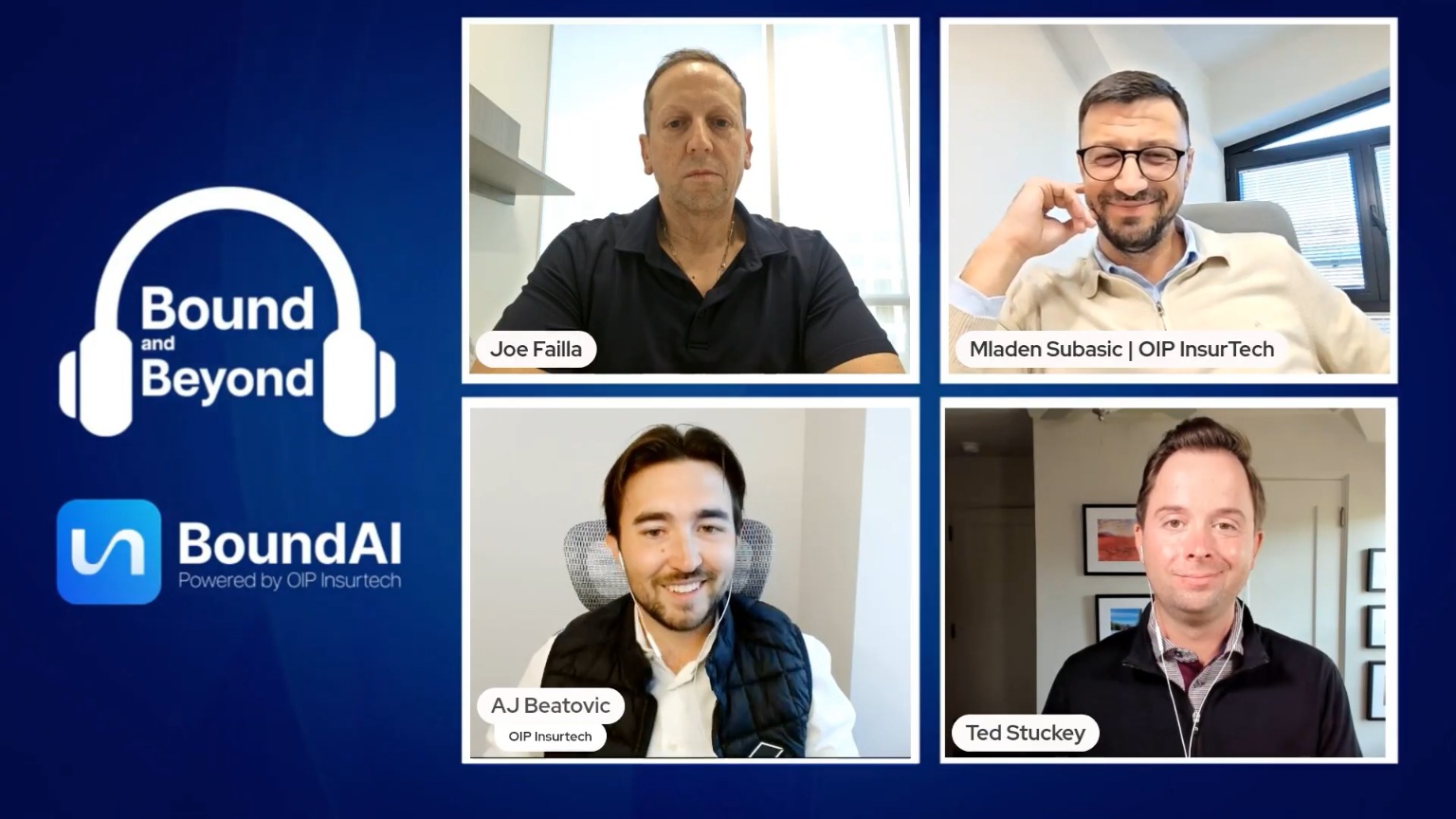
BSG leaders and OIP Insurtech’s Mladen Subasic share what it takes to make submission AI part of daily work.
BSG leaders and OIP Insurtech’s Mladen Subasic share what it takes to make submission AI part of daily work.
Three to four years ago, Bridge Specialty Group put a submission automation engine into daily use with OIP Insurtech and BoundAI. In Episode 3 of Bound and Beyond (hosted by AJ Beatovic), BSG's Ted Stuckey (Regional President, Central & West) and Joe Failla (COO) joined Mladen Subasic (Chief Product Officer at OIP Insurtech and BoundAI) to walk through how it has gone.
Here are the key takeaways.
BSG became the company it is today through a series of acquisitions, and so each office has its own way of working. Ted described the balance that leadership is looking for: standardize where it removes fragmentation and protect what made each business so good. The offices drive the revenue, and the best technology decisions start with listening to the gaps the offices themselves describe.
Joe added that automation and AI raise the stakes on that balance. "You can't go build it 30-something or 40-something different ways by office," he said, which is why you absolutely need a shared foundation.
The starting point was a data challenge. BSG wanted structured data from every submission without asking the very busy front line to key it in manually. As Joe explained: What you don't always want to do is go to the front lines and ask our people sitting at the desk to go enter countless amounts of data. They're already busy, you know, their days are full.
Ted joined the company post-launch and has seen what that data enables. In a soft market, you can actually describe what's going on in the business at a level of detail that was not possible before the engine. "I can't imagine not having that data. All the other things we're talking about wanting to do and build out, the roadmap from a technology perspective at Bridge, I can't think of one that doesn't tie back into submission engine in some way," Ted said.
Mladen attributes the project's success to a very clear target. BSG came to the table with a very real workflow problem and a desire to solve it before the market. That focus kept the scope very tight. The objectives were speed to market and faster clearance. It was all about reducing the time to extract key data from PDFs and the time to check whether an account was already written. The initial time to get a submission into the process was a couple of minutes, and now it's almost nothing.
Measurement was central to the partnership from day one. OIP Insurtech sends BSG monthly and quarterly reports covering cycle time, processing lineage, and accuracy scores for each data point. Mladen described accuracy as the unit of value. The experts review what the machine produces and feed it back into the learning loop.
Uptake varied widely at the outset. Some offices took to the engine immediately, others used it very little, and BSG's ability to measure uptake meant you could have the right conversation with each office. Those conversations inevitably uncovered some real edge cases. Offices dealing with a relatively small number of very large accounts each month saw considerably less uplift than those processing thousands of submissions. Some lines of business had data that the engine wasn't built to capture. They fed that feedback into the product roadmap.
Joe talked about the human side of adoption. Operations will tell you why the technology is in use and how to use it. Executive leadership will reinforce that message. "You've got to win hearts and minds," he said. Mladen suggested treating an internal rollout like a market product launch.
The results are evident in the day-to-day work. "It's part of the muscle memory for teammates as they're going through their submission intake process," Ted explained. He could think of only one edge case that still falls outside the engine.
Mladen shared a pattern he's been seeing all over the industry. "80% of the attention and budgets are going towards growing the business with AI. What we are actually seeing producing today is on the flip side. We see 80% of gains on the execution operational layers while 20% are only made on the growth side."
Joe explained why operations offer the clearest returns. "It's easier to get the bang for your buck on the operational side as it's a workflow," he said, as you can put AI into a defined workflow and then measure the improvement. Ted added that the engine made it practical to go with an open architecture, with components in the stack for specific use cases, so you didn't need a single platform to do it all.
BSG has built the bridge and owns the bits of the engine that matter to the long-term architecture, and works with partners on the rest. Ted has a rather different view of the bigger picture than is normally the case. "I almost think that the build versus buy discussion is antiquated at this point," he said. To him, it's all about adoption and the sustained benefits.
Mladen pointed to where the company's own effort should be. "It's not build or buy anymore by a mile. What you build, what you experiment with, should be your alpha. It's the thing that makes customers come to you and not come to the shop next to you is where you should be investing. And hire everything else.”
That partnership model got the BSG end absolutely raving. One BSG figure said OIP had been "in the trenches" with the team "learning about why we do things the way we do things."
Submission automation is now firmly on the BSG technology roadmap, and the partnership will continue to evolve as the business grows. If you'd like to see how OIP Insurtech and BoundAI handle submission intake for the specialty insurer market, feel free to contact our team.