New
Workflow Intelligence Diagnostic: uncover friction, capacity leaks, and AI opportunities in 9-12 weeks.
Senior executives from Ki, Mosaic, Zurich Global Specialty, and Palomar gathered at OIP Insurtech’s ITC Vegas roundtable to discuss how frontier AI models are reshaping the buy versus build decision and what vendor contracts need to look like going forward.
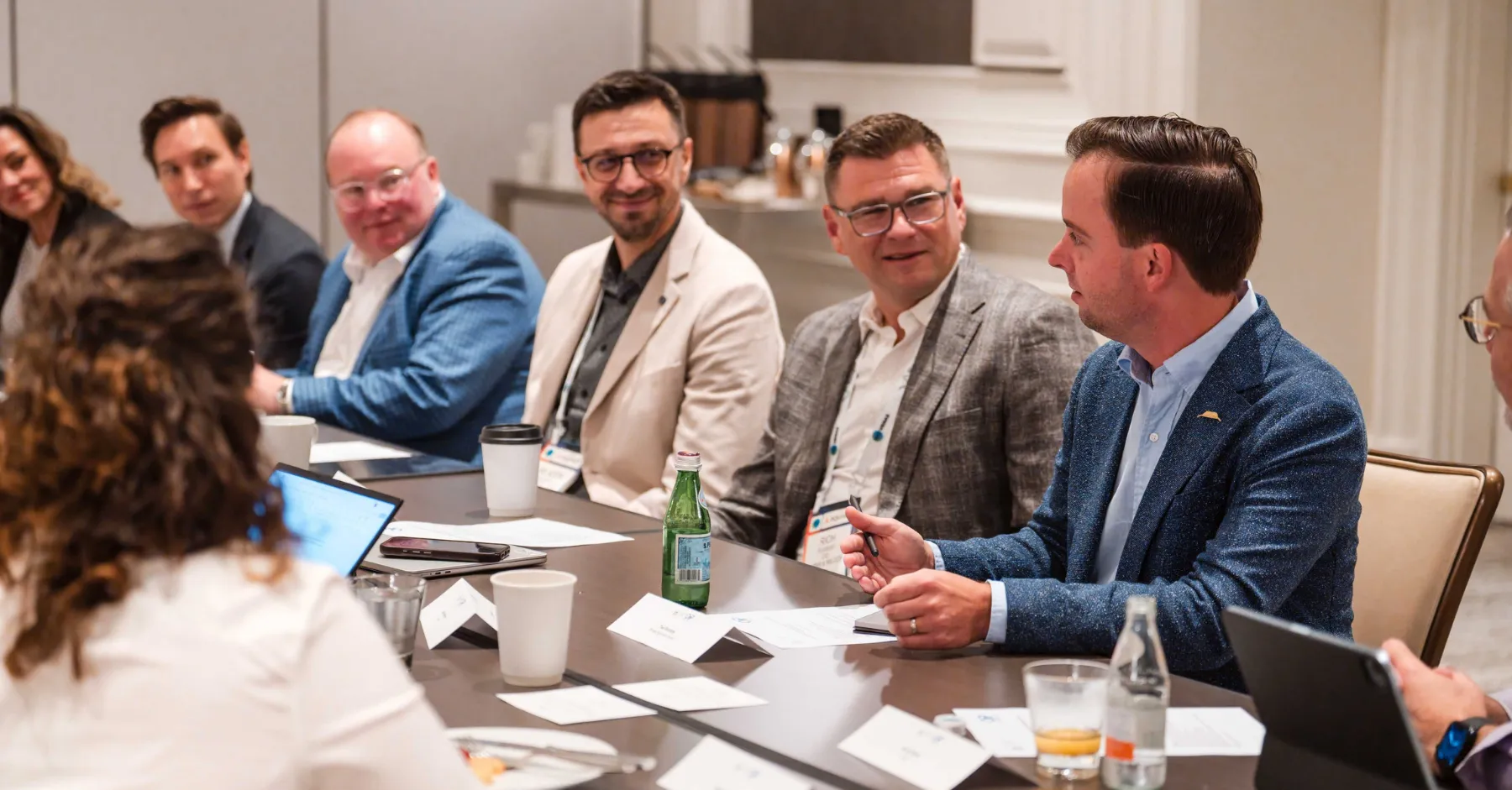
Senior executives from Ki, Mosaic, Zurich Global Specialty, and Palomar gathered at OIP Insurtech’s ITC Vegas roundtable to discuss how frontier AI models are reshaping the buy versus build decision and what vendor contracts need to look like going forward.
The 'buy vs build' question in insurance AI has always been a straightforward one. You either buy it or you build it. What came out of the OIP Insurtech roundtable at ITC Vegas (hosted by Insurance Insider) is that the very framing of the question is now evolving.
Frontier AI models are giving brokers and carriers far more options to build in-house than they had two years ago, and that shift is already beginning to impact buying decisions in ways the market hasn't quite gotten to grips with yet.

One carrier exec at the roundtable mentioned that an AI had in fact completely replaced a vendor's product. Another person at the meeting said they'd looked at 30 vendors for a submission intake product before ultimately deciding they could build it themselves.
The view wasn't that building is always better. The view was that organizations with the right infrastructure now have a choice, and that choice should be taken seriously before signing off on a contract.
Yosha DeLong, global engagement officer at Mosaic Insurance, explains that Mosaic has put in place a team of six forward development engineers (all with master's degrees and based in London, with plans to grow that to six more). Their role is to identify where AI can have the most impact and to work out what Mosaic can build in-house and what it needs to go to a specialist vendor. "That enables us to be much more targeted in our approach to external partners and much clearer about the ROI we're looking for," she says.
The rate of AI development is making traditional contract models increasingly untenable. Reid Stanway, head of digital at Ki, said it quite simply: "The purchase patterns are going to be fundamentally different in this space. With the rate at which the technology is moving, you're going to need that optionality to be able to shift."
He expects new AI vendor agreements to be one to two years, with a one-year break clause, rather than the three- to five-year commitments that have been the norm. The room has moved away from the "all or nothing" contract model towards something more flexible, which makes sense given how quickly the landscape is changing.
One carrier rep actually summed it up quite simply: they're looking for partners, not vendors. Where the tech vendor is finding efficiencies via AI, those efficiencies should be passed through to the carrier as well.

The roundtable touched on the fundamental questions around AI deployment that so many organizations are still grappling with. The roundtable reached broad agreement on several core principles.
Start with a roadmap. The firm needs a clear view of where AI fits in its strategy before committing to any individual solution. You need to have a very precise definition of the problem you're trying to solve before you go and pick a tool. And you need to measure continuously after you've deployed it, not just at launch but at 30, 60, and 90 days.
Stanway explains how Ki approaches AI from both a bottom-up and a top-down perspective. The bottom-up approach is where staff are the builders. They're going out and testing the tool against real business problems to see what works. The top-down approach focuses on data extraction for specific workflows. "A good example is a broker connecting their systems to ours. In the past, we'd have to choose to either push them to give us all 40 pieces of data we need to quote/settle on, or go with the 20 they can easily provide. Now we can use our AI extraction tools to pull together the bits we're missing. It's not a magic bullet by any means, but where it works, the brokers don't have to re-key as much."
Girish Rao (head of A&H operations at Zurich Global Specialty) brings up the risk that underlies every AI investment decision being made right now. You could be absolutely convinced to bet the farm on a use case or a company's technology today and a year down the track find that the company is gone, or that the use case you're trying to solve has become a default out-of-the-box capability that one of your existing partners can provide.
His advice was to spread the bets across a few areas (customer experience, individual productivity, operational efficiency) and be very deliberate about how deep you go on each one. The room also raised the issue of "AI ghost towns" (tools that haven't delivered, which you keep running because you'd feel like you were admitting failure if you turned them off, which in turn quietly eats into your EBITDA).
Rudy Herve, Palomar's COO, took a more realistic approach. Palomar's AI journey began with a process review and a focus on where increased efficiency would directly translate into output. "We didn't start with one central AI solution," he said. "Outside of engineering, we had a population of super users (actuaries, data scientists, ops managers) who found a whole host of small wins which we could then measure. Those wins and proof points are now what allow us to self-fund the next step."
The roundtable concluded with a point that brought the discussion together: AI ROI metrics need to be clear enough for the wider business to understand, measurement needs to be continuous, and AI initiatives are far more likely to succeed when pitched as business projects rather than IT projects.